This year, I decided to curate my readings: I only read books written by women. And I tried to choose Latin American women, although I wasn't too picky about that. Here are some thoughts on the subject:
- I read 11 writers I hadn't read before, and several of whom I wasn't even aware existed.
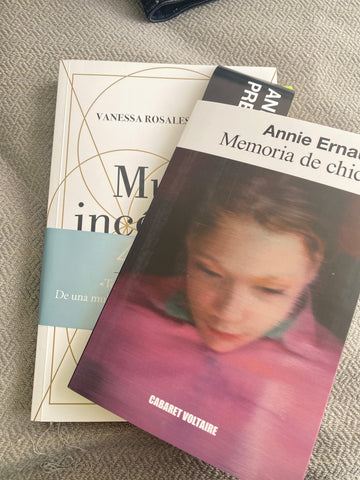
These are their names and the titles I chose: Lorena Salazar Masso ( This Wound Full of Fish ), Laura Ortiz ( Sofoco ), Verónica Gerber Bicecci ( Empty Set ), Betty Martin ( The Art of Receiving and Giving: The Wheel of Consent ), Arelis Uribe Caro ( Quiltras ), Laura Acero ( Paramera ), Annie Ernaux ( Pure Passion, Girl's Memory ), Chimamanda Ngozi Adichie ( Something Around Your Neck, The Danger of the Single Story ), Amalialú Posso Figueroa ( I Measure My Quarter and Stand on It ) and Vanessa Rosales Altamar ( Uncomfortable Woman ).
- I can't explain how much it changed my approach, especially my desire for intimate writing, which has always existed but has never managed to outweigh my fear of appearing fragile or too "desirous." It also changed my approach to raw writing, and, above all, it changed my way of thinking about complex writing, which I previously viewed as a form of bombastic makeup of ideas and which today, thanks to Vanessa Rosales Altamar, I see as a weighty political decision.
- In my internal discourse, I've appealed to accessibility in language and storytelling as a kind of kindness toward readers. (Partly due to a difficulty inherent in accessing complexity—I don't know if it's due to my short attention span, or a feeling of inadequacy left by reading a few things by Mereau-Ponty, Husserl, and Heidegger in college.) But I'd never before seen that "kindness" as what it possibly is in my case, which is a mixture of servility and condescension. And not just in writing but in reading as well. I almost gave up on Vanessa Rosales Altamar's "Uncomfortable Woman"—which I still haven't finished—in the first few pages before imagining that that was possibly the purpose: to write a book to explain, complicating both the form and the content, what it means to be a woman—situated where she is. And then my justification for "simple and accessible" readings completely changed, and it got me into serious trouble. In other words, “it made me uncomfortable.”
- Without meaning to, and without my book dealer 's imagining it, there's one thing in common among most of the titles we chose this year: women as desiring subjects , not just desired objects. It's no coincidence. These are the other stories of desire: the ones women write. We are no longer just—according to what the books tell us—inspiring muses, observed objects. We are also observers, desiring subjects, sexualizing subjects, and not just sexualized ones. Women now—according to the books—also masturbate, we also want to get divorced, write books, understand the world, we get bored, and we are political subjects. Women now—according to the books—know about the different layers of our vulva—or susuné—and we do and do not desire children. Women now—according to the books—make decisions about our bodies. And now—according to the books—we not only suffer from hysteria, but also from injustice, from disgust with our assigned life, from unhappiness. Nowadays—according to the books—we don't marry by choice. All this isn't because we haven't been or done it before, but because now the books tell it because women write books too. These other stories of desire have always existed, but we haven't always read them. This year I did it, and I hope the rest of the world does too, with much more discipline.
- My curation for next year may be of living writers. I still have quite a few books I purchased under the 2022 curation, and fortunately, most of them are by living women. I like to think that what there is to learn from temporary or permanent chastity isn't so much the prohibition itself, but what arises from the prohibition. And I think self-curating books each year is a good way to do it.